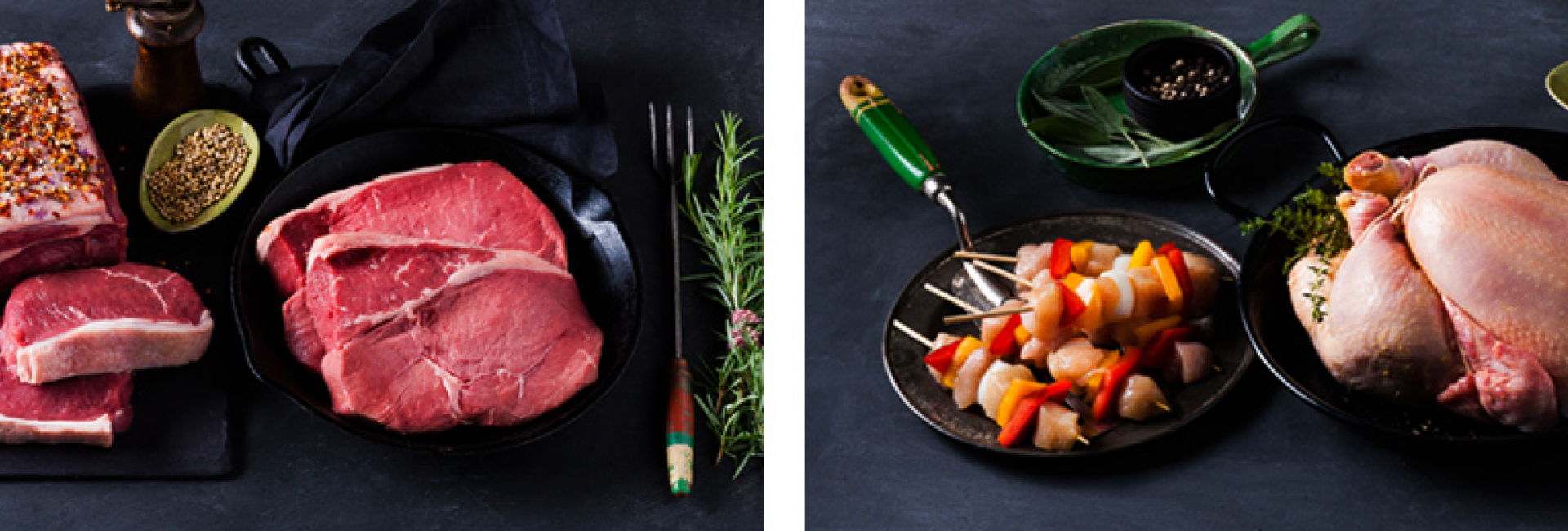
Here at N1, one of South Africa’s leading wholesale meat suppliers, you’ll find a wide variety of high-quality red meat and white meat products, but have you ever wondered why steak is a vibrant red while chicken meat is white? Well it all comes down to muscle type: slow-twitch versus fast-twitch; and chemistry.
Slow-twitch muscles contract slowly and because they're crucial for endurance they allow energy to be released gradually over extended periods of time. These muscle types rely on a protein called myoglobin which has a red pigmentation – the more of it present in the muscle, the darker and redder the meat. Myoglobin stores oxygen and it helps to keep the muscle functioning as it should. Interestingly enough diving mammals such as whales and seals have high concentrations of myoglobin and therefore oxygen resources, which in turn allows them to hold their breath for far greater periods of time.
By contrast, fast-twitch muscles work more quickly to support swifter motion – think chicken versus cow: the former fast-moving and always active, the latter slow and lethargic. While slow-twitch muscles rely on myoglobin, fast-twitch muscles rely on the lighter glycogen for its energy source.
Fresh red meat will always be a vibrant red to begin with thanks to oxygen binding with iron atoms. What happens as meat ages is that the myoglobin protein loses its ability to keep binding the atoms and that’s when the meat begins to turn brown. This may also be the case with sealed and packaged meat where a loss of oxygen in the vacuum seal sometimes turns the meat from pink to brown.
The change in colour that occurs when cooking meat is also down to myoglobin. According to Exploratorium and its Science of Cooking ‘When dark meat is cooked, myoglobin's colour changes depending on what the meat's interior temperature is. Rare beef is cooked to 60° C, and myoglobin's red colour remains unchanged. Above 60° C, myoglobin loses its ability to bind oxygen, and the iron atom at the centre of its molecular structure loses an electron. This process forms a tan-coloured compound called hemichrome, which gives medium-done meat its colour. When the interior of the meat reaches 77° C, hemichrome levels rise, and the myoglobin becomes metmyoglobin, which gives well-done meat its brown-grey shade.’
So there you have it, the why and how behind the colour of your meat – and while you’re contemplating red and white meat, don’t forget that National Braai Day is coming up soon, so be sure to call N1 today to stock up.