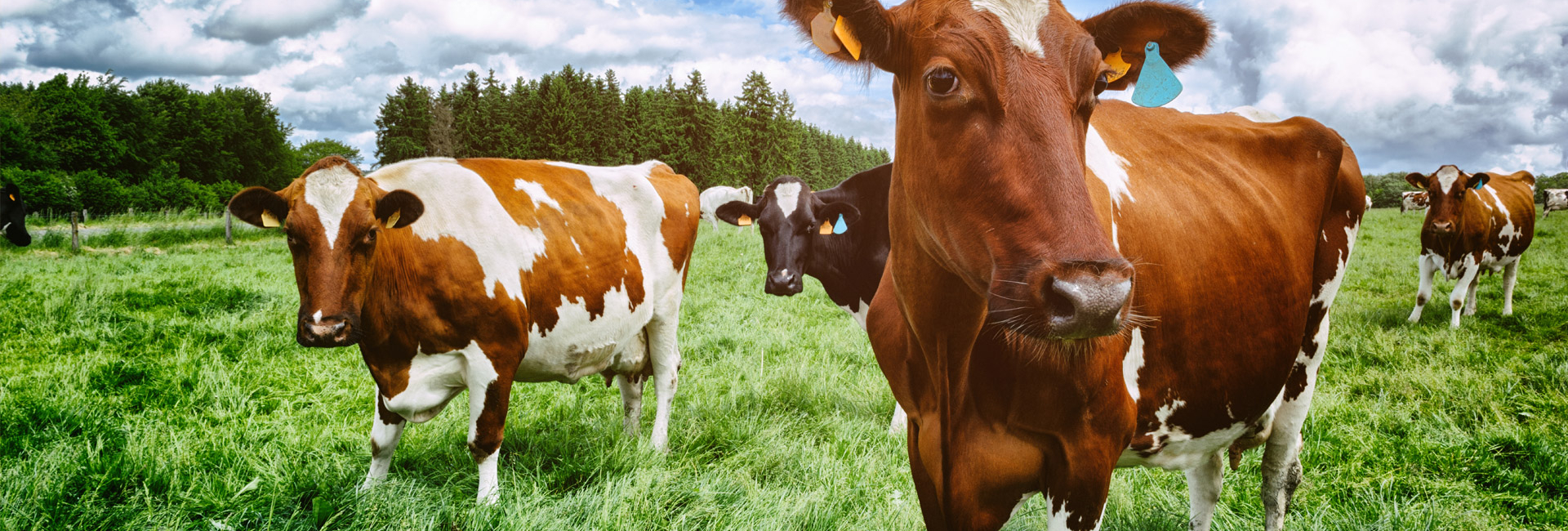
Meat wholesalers South Africa know that producing food from animals results in greenhouse gas emissions. All animals breathe out carbon dioxide (humans included); and domestic livestock such as cattle, buffalo, sheep and goats all produce methane gas as part of their normal digestive process – although industry and waste management activities are also responsible for methane emissions. But in an age where we are all trying to reduce our carbon footprint, there are ways and means to do the same when it comes to livestock.
A report by Cornell University in 2013 states that the carbon hoofprint of dairy cows may in fact be smaller than we originally thought. According to Michael Van Amburgh, a professor of animal science, ruminants such as cows and sheep are actually the best kind of recyclers, because they are often fed by-products which otherwise would have been incinerated causing a greater adverse environmental effect. An example he gives is that of the California almond industry ‘that relies on cattle to consume four billion pounds of shelled almond hulls each year’. Van Amburgh goes on to say that while we can precisely calculate a cow’s carbon output (thanks to a model developed at Cornell) and tweak their diets accordingly, we can’t decrease the cow’s methane production by much, so it’s important to also focus on changing and improving the efficiencies of said food source; and considering its nutrient density in relation to its emission status. To better illustrate this, a 2010 Swedish study found that milk has a ‘high nutrient density index per equivalent carbon emission of 53.8 per 99 grams of greenhouse gas emission; soy drinks and red wine, by comparison, have a nutrient density index of 7.6 per 30 grams and 1.2 per 204 grams of emissions respectively’.
Another way to minimise environmental impact is via a biogas recovery system. Homestead Dairy in Plymouth, Indiana, is a family-run farm that uses the system to transform manure and other waste into electricity – enough to power 1,000 homes in fact. The Environmental Protection Agency (EPA) estimates ‘that more than three million tons of greenhouse gas emissions were eliminated last year [2014] by Homestead and the 246 other US livestock farms which have installed biogas recovery systems. That’s equivalent to taking more than 630,000 cars off the road’. Amongst meat wholesalers South Africa, an example of this can be found at Morgan Abattoirs which began developing a biogas plant to safely eliminate waste and produce alternative energy making its operation near self-sustainable. Their MD, Dirk Groenwald, quoted online in Africa Outlook, said ‘We estimate that the biogas plant will be able to supply us with nearly 65% of our electricity and 90% of our heat/warm water needs.’
Taking innovation and sustainability even further is Ireland; it launched Origin Green and The Sustainable Dairy Assurance Scheme (SDAS). The first national dairy scheme of its kind in the world and implemented on Ireland’s 18,000 dairy farms, it ‘calculates the greenhouse gas emissions of each participating dairy herd using the carbon navigator tool and provides detailed feedback to each farmer helping them to improve the sustainability performance of their farm’.
While meat wholesalers South Africa and associated industries may not yet be where Ireland’s at in terms of reducing carbon hoofprint, something all food-related industries can do to minimise its national carbon footprint is to reduce food waste, because according to the Food and Agriculture Organisation of the United Nations (FAO) each year wasted food is responsible for a staggering 3.3 billion tonnes of greenhouse gas emissions!