

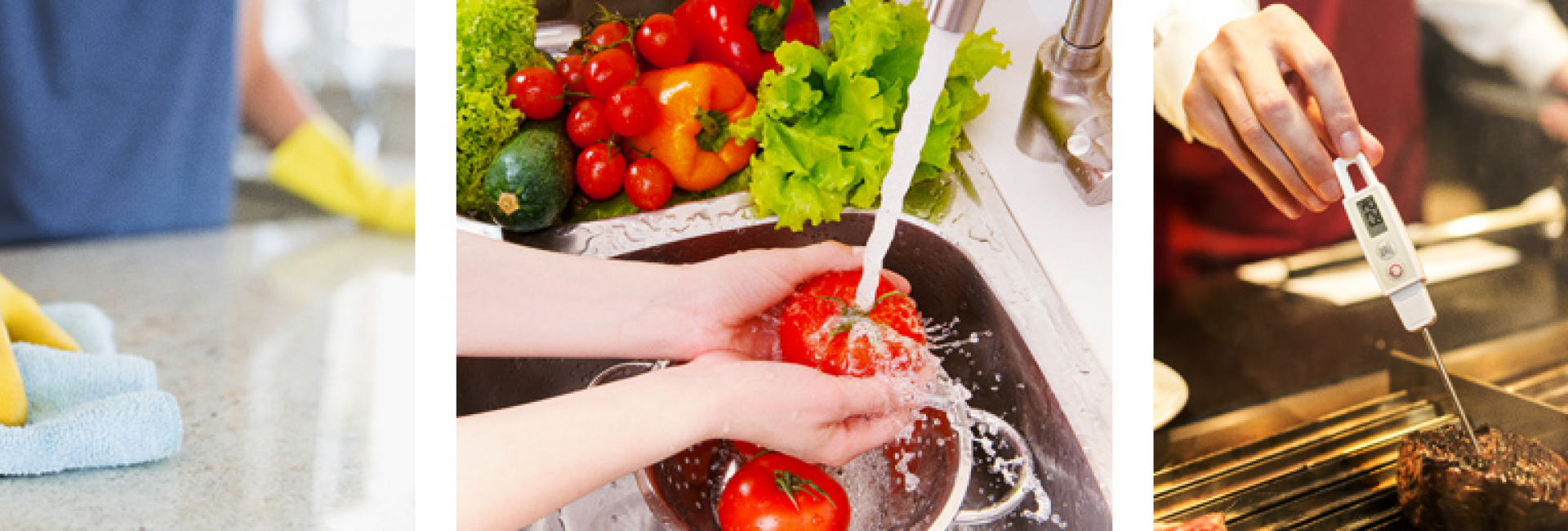
Regardless of where you might be this festive season, a large part of celebrating the holidays will undoubtedly revolve around preparing delicious meals for family and friends. In an effort to keep the holidays incident-free – after all, no one wants to be known as the never-going-to-eat-there-again host – here are a few reminders, courtesy of FoodSafety.gov and their ‘Food Safe Families’ campaign, on how to keep everyone who eats at your table, happy and healthy.
CLEAN
It goes without saying, but we all tend to forget sometimes, how important it is to ensure hands, cutting boards and utensils are all clean before beginning any kind of food prep. And not just wipe with a dishcloth clean, but hot water and soap clean. This includes cleaning your hands during food preparation, particularly if you’re touching raw meat.
SEPARATE
It’s advisable to always keep any raw foods away from ready-to-eat foods. If you’re storing or defrosting uncooked foods in the fridge, be sure to keep them in a plastic bag or in their own bowl to prevent any harmful bacteria that may be in the juices from contaminating your ready-to-eat foods. Remember to use separate cutting boards for all your raw foods, and if your raw meat came in a marinade, don’t use the marinade on the cooked meat unless you’ve boiled the sauce first.
COOK
While many of us judge the readiness of our cooked meat and poultry by its colour or texture, the only way to truly know if food has cooked to a safe minimum internal temperature – one at which any harmful bacteria has been destroyed – is to use a food thermometer. The guidelines provided recommend that beef, pork, veal and lamb be cooked to an internal temperature of 63 °C with poultry slightly higher at 74 °C. Also remember that when you microwave something, you need to stir the food to ensure the heat is distributed evenly throughout, too often we zap something in the microwave only to find the outside blisteringly hot while the inside is still cool to the touch.
CHILL
The ideal temperature at which to keep your fridge is between 3 and 4 ° Celsius. Keep in mind that temperatures can also vary within your fridge – the coldest part is just above your vegetable tray so this is the ideal place to keep meat, fish and poultry. When it comes to defrosting food, your refrigerator is the best place; food should never be left on a counter or in hot water to thaw, and it should not be left at room temperature for more than two hours – particularly now during the summer months, because bacteria multiplies faster in the heat.
So there you have it – the four essential components to being food safe this holiday.
And finally, as the year draws to a close and our thoughts turn gratefully to all those who have made our progress possible, we want to say a simple but sincere ‘thank you and best wishes for a Happy and Healthy Festive Season – may the year ahead be filled with peace and prosperity for all.’
- The N1 Team